Insight
What is modern leadership – and how does your board need to adapt?
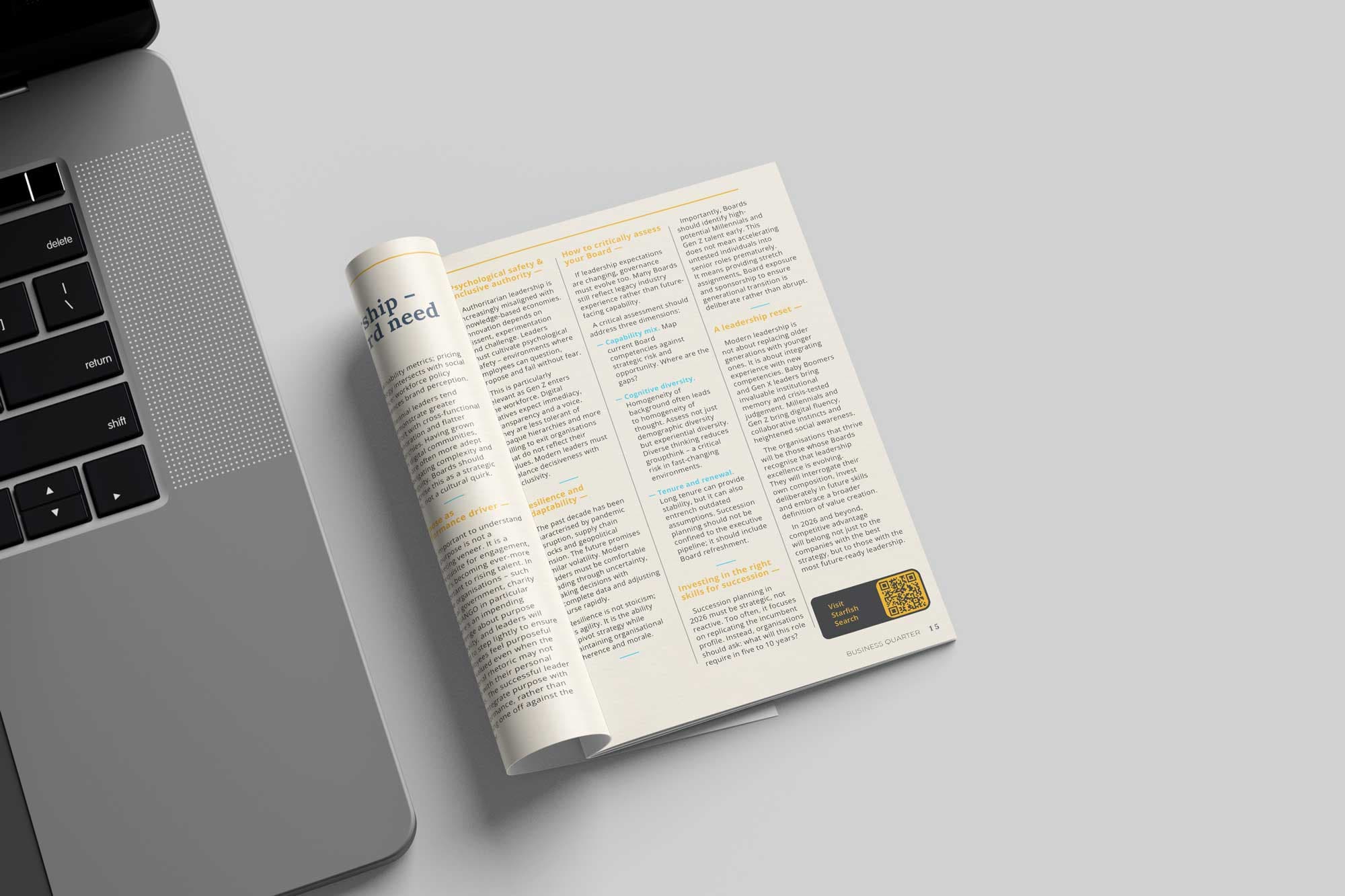
By: Juliet Taylor, CEO & Founder, Starfish Search
In boardrooms across the UK and Europe, the profile of the leader remains relatively familiar. Many CEOs and Chairs are Baby Boomers or Gen X: seasoned operators shaped by globalisation, financial crises and the rise of shareholder primacy. Yet the context in which they now lead is fundamentally different, with societal shifts having redefined what effective leadership looks like.
The idea of the ‘modern leader’ is not about age. It is about mindset, capability and adaptability. As Millennials move decisively into executive roles and Generation Z – the so-called Zoomers – begin to shape organisational culture and consumer expectations, Boards must reassess what leadership excellence means in 2026 and beyond.
Digital fluency at strategic level
Digital literacy is no longer a CIO-only concern. Artificial intelligence, automation, cybersecurity and data ethics are core strategic issues. Leaders may not need to code, but they must understand technology’s implications for operating models, risk, talent and value creation.
This requires moving beyond digital transformation as a project and treating it as a permanent capability. Boards should ask: does our leadership team truly understand the commercial, ethical and regulatory implications of AI deployment? Or are we delegating the most profound shift in business architecture to technical specialists?
Systems thinking over siloed expertise
The modern enterprise is a network: supply chains, ecosystems, partnerships and platforms. Leaders must think in systems rather than functions. Decisions in procurement affect sustainability metrics; pricing strategy intersects with social licence; workforce policy influences brand perception.
Millennial leaders tend to demonstrate greater comfort with cross-functional collaboration and flatter hierarchies. Having grown up in digital communities, they are often more adept at navigating complexity and ambiguity. Boards should recognise this as a strategic asset, not a cultural quirk.
Purpose as performance driver
It’s important to understand that purpose is not a marketing veneer. It is a prerequisite for engagement, and it’s becoming ever-more important to rising talent. In some organisations – such a local government, charity or QUANGO in particular – there’s an impending challenge about purpose vs reality, and leaders will need to step lightly to ensure employees feel purposeful and valued even when the national rhetoric may not align with their personal views. The successful leader will integrate purpose with performance, rather than trading one off against the other.
Psychological safety & inclusive authority
Authoritarian leadership is increasingly misaligned with knowledge-based economies. Innovation depends on dissent, experimentation and challenge. Leaders must cultivate psychological safety – environments where employees can question, propose and fail without fear.
This is particularly relevant as Gen Z enters the workforce. Digital natives expect immediacy, transparency and a voice. They are less tolerant of opaque hierarchies and more willing to exit organisations that do not reflect their values. Modern leaders must balance decisiveness with inclusivity.
Resilience and adaptability
The past decade has been characterised by pandemic disruption, supply chain shocks and geopolitical tension. The future promises similar volatility. Modern leaders must be comfortable leading through uncertainty, making decisions with incomplete data and adjusting course rapidly.
Resilience is not stoicism; it is agility. It is the ability to pivot strategy while maintaining organisational coherence and morale.
How to critically assess your Board
If leadership expectations are changing, governance must evolve too. Many Boards still reflect legacy industry experience rather than future-facing capability.
A critical assessment should address three dimensions:
- Capability mix. Map current Board competencies against strategic risk and opportunity. Where are the gaps?
- Cognitive diversity. Homogeneity of background often leads to homogeneity of thought. Assess not just demographic diversity but experiential diversity. Diverse thinking reduces groupthink – a critical risk in fast-changing environments.
- Tenure and renewal. Long tenure can provide stability, but it can also entrench outdated assumptions. Succession planning should not be confined to the executive pipeline; it should include Board refreshment.
Investing in the right skills for succession
Succession planning in 2026 must be strategic, not reactive. Too often, it focuses on replicating the incumbent profile. Instead, organisations should ask: what will this role require in five to 10 years?
Importantly, Boards should identify high-potential Millennials and Gen Z talent early. This does not mean accelerating untested individuals into senior roles prematurely. It means providing stretch assignments, Board exposure and sponsorship to ensure generational transition is deliberate rather than abrupt.
A leadership reset
Modern leadership is not about replacing older generations with younger ones. It is about integrating experience with new competencies. Baby Boomers and Gen X leaders bring invaluable institutional memory and crisis-tested judgement. Millennials and Gen Z bring digital fluency, collaborative instincts and heightened social awareness.
The organisations that thrive will be those whose Boards recognise that leadership excellence is evolving. They will interrogate their own composition, invest deliberately in future skills and embrace a broader definition of value creation.
In 2026 and beyond, competitive advantage will belong not just to the companies with the best strategy, but to those with the most future-ready leadership.