Insight
Charity Non-executive State of the Market update
Welcome.
Almost 50% of all appointments handled by Starfish in the Social and Public Policy sectors are non-executive. These include Chairs, Committee Chairs, Senior Independent Directors, Trustees, Non-executive Directors, Co-optees, Panel members and Presidents.
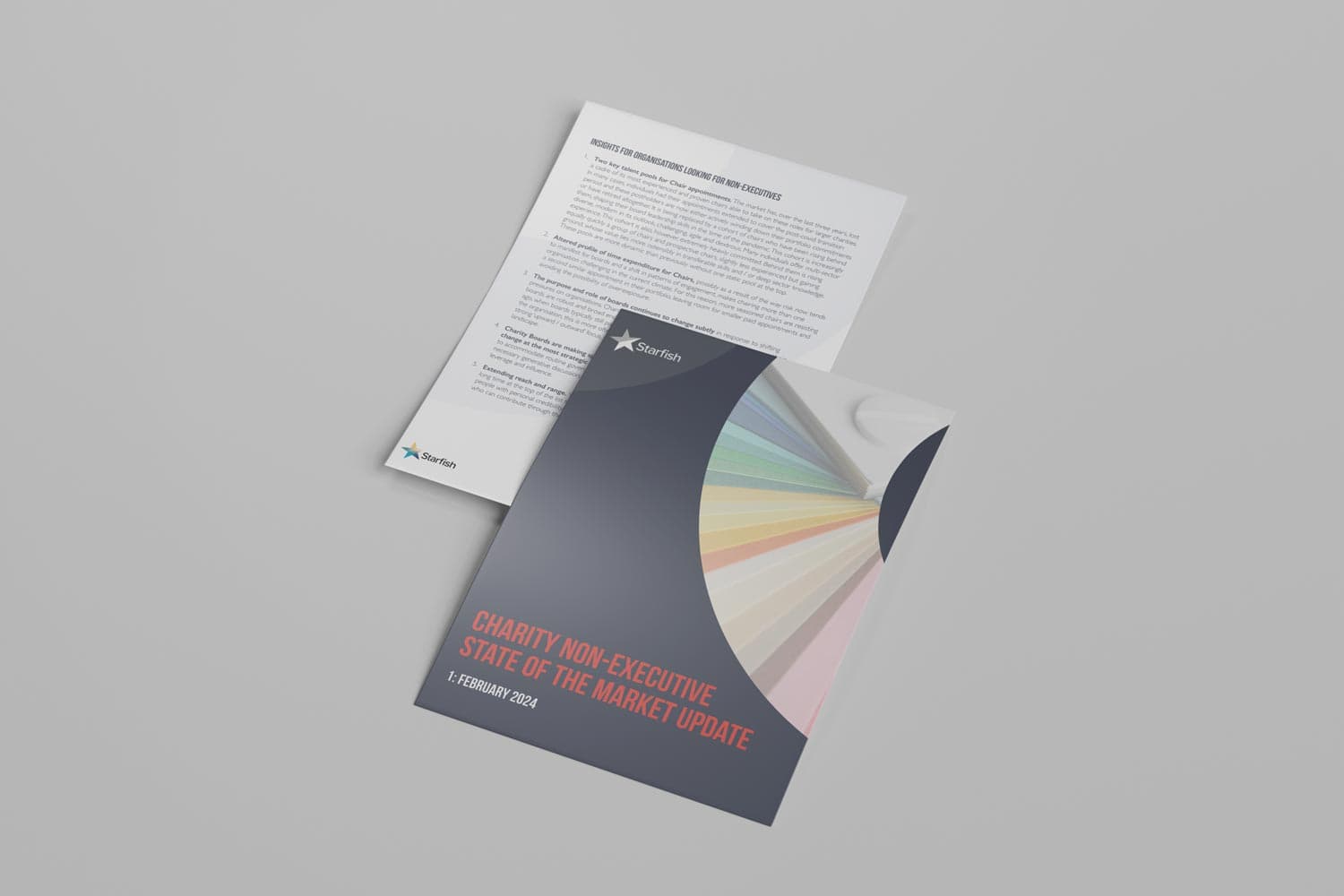
The Starfish Board Practice produces topical, insight-led reviews from time to time on a range of different board room subjects. This is our first ‘state of the market’ update, in which we provide five insights to guide thinking for organisations considering securing new non-executives, and five more for individuals who may be thinking about securing a non-executive appointment on a charity board.
Starfish Board Practice. Defining the times we live in through the people we meet and their own stories. 2024 is our year of hope and optimism.
Insights for organisations looking for non-executives
- Two key talent pools for Chair appointments. The market has, over the last three years, lost a cadre of its most experienced and proven chairs able to take on these roles for larger charities. In many cases, individuals had their appointments extended to cover the post-covid transition period and these postholders are now either actively winding down their portfolio commitments or have retired altogether. It is being replaced by a cohort of chairs who have been rising behind them, shaping their board leadership skills in the time of the pandemic. This cohort is increasingly diverse, modern in its outlook, challenging, agile and dextrous. Many individuals offer multi-sector experience. This cohort is also, however, extremely heavily committed. Behind them is rising equally quickly a group of chairs and prospective chairs, slightly less experienced but gaining ground, whose value lies more ostensibly in transferable skills and / or deep sector knowledge. These pools are more dynamic than previously without one static pool at the top.
- Altered profile of time expenditure for Chairs, possibly as a result of the way risk now tends to manifest for boards and a shift in patterns of engagement, makes chairing more than one organisation challenging in the current climate. For this reason, more seasoned chairs are resisting a second similar appointment in their portfolio, leaving room for smaller paid appointments and avoiding the possibility of over-exposure.
- The purpose and role of boards continues to change subtly in response to shifting pressures on organisations. Charities are continuing to take stock frequently, to ensure their boards are robust and broad enough to steer a changing course. Compared with just a few years ago, when boards typically still paid significant attention to their ‘inward / downward’ focus into the organisation, this is more often matched in 2024 by demand for trustees who can bring a strong ‘upward / outward’ focus, grounding the organisation in its stakeholder, public and political landscape.
- Charity Boards are making space for innovation and for the incubation of positive change at the most strategic level of the charity. Committee structures are strengthened to accommodate routine governance procedures and disciplines, freeing up board time for necessary generative discussion, horizon scanning and the promulgation of collective networks, leverage and influence.
- Extending reach and range. Whereas subject knowledge and governance skills were for a long time at the top of the list for board roles, these are now challenged by as much demand for people with personal credibility, links and connections with key communities and audiences, and who can contribute through their personal and lived experiences.
Insights to help individuals who are looking for non-executive roles
- In the current market, it is less likely that a lack of non-executive experience alone will hold you back. Consider other ways in which you have been personally influential or inspired change. Your capacity to think strategically about complicated issues, bridge gaps, connect with emerging audiences or help an organisation address its blind spots may be as relevant to the Board’s overall aim. In many ways, 2024 is a year for ‘grit in the oyster’: organisations are asking for active and constructive challenge power.
- The broadening out of boards in their perspective means that more organisations are willing to explore a broader cross-section of backgrounds and experiences when selecting their trustees. Begin a covering letter with a paragraph exclusively about the organisation you are interested in to show you understand its unique situation, can anticipate the level and nature of discussion you’ll be involved in, and have sized up the opportunities and risks ahead for the team.
- A role with no pay is not the same as a role with no value. Boards occupy an exposed position in early 2024 and it is not possible to carry out chair or trustee roles properly without a serious interest in what the organisation is trying to achieve, in task or mission. In 2024, candidates need to be comfortable with collective and individual accountability before they commit. The debate about trustee pay is, in some senses, being slowly re-opened; yet significant change across the sector is looking unlikely in present circumstances.
- More and more people have been tuning in to their sense of social purpose as we grapple with the big issues of our lifetime. Does the growing community of people now expressing an interest in charity board roles from all sectors reflect an increase in awareness of the value of social responsibility? Applicants are also considering board work earlier in their working lives, because of the reduced requirement for all trustees to have held conventional leadership positions. If you are motivated by positive change, modern charity board work can be combined successfully with full time work in most sectors. Candidate fields are bigger for trustee roles; however, there are more genuinely accessible opportunities available at the moment.
- Understand what conflict of interest and perception issues really mean. In an age of heightened speculation and rapid digital clockspeed, board work is exciting, yet understanding ‘optics’ is critical. Strong applicants for charity trustee roles in 2024 readily take accountability; they operate with a high level of self-awareness, optimism and common sense.
Starfish Board Practice. Chair search. Trustee and NED search. Patron and President search. Board Effectiveness Reviews. Skills and diversity audit and succession planning. Consultancy in developing board culture and dynamics. Our client list is available on request.